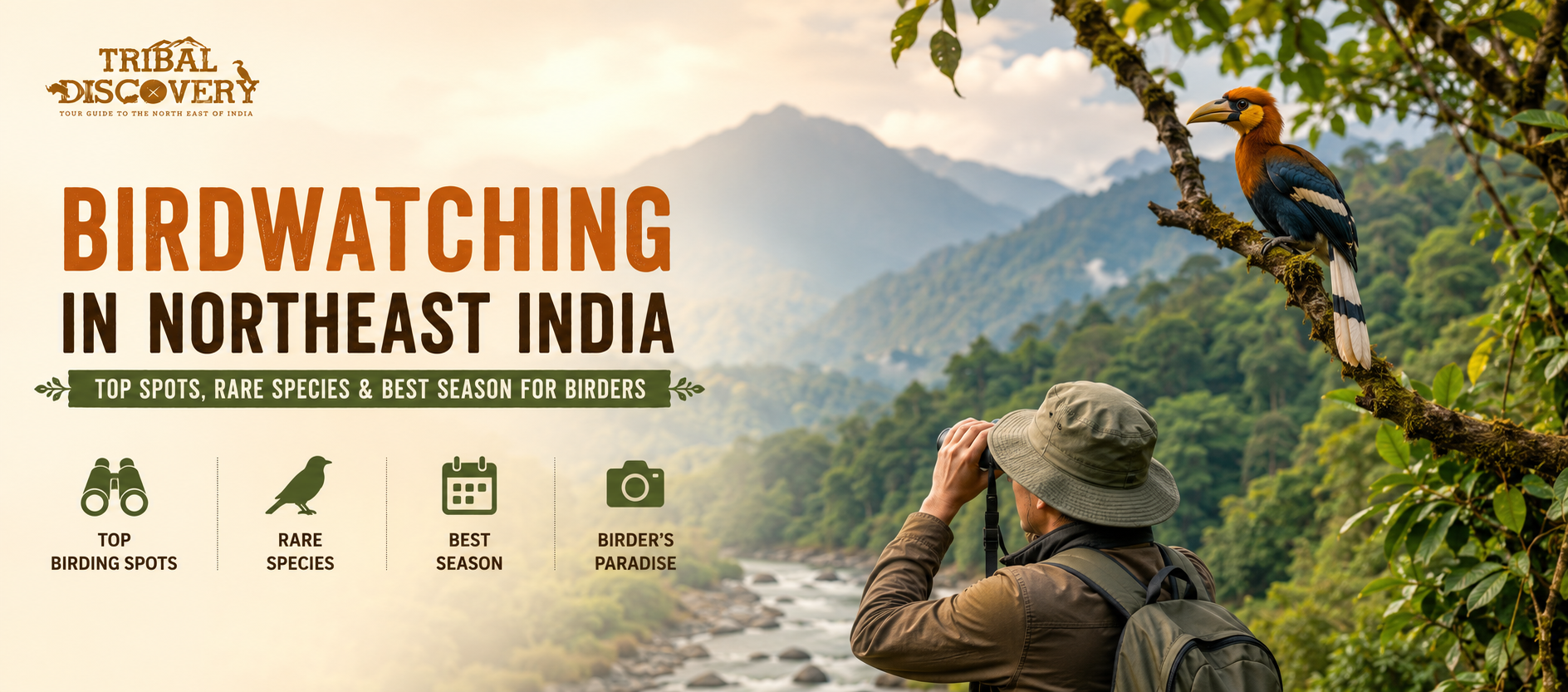
Northeast India is not simply a good birdwatching destination. For serious birders, it is one of the most important regions in all of Asia. Sitting at the convergence of the Indo-Malayan, Indo-Chinese, and Eastern Himalayan biogeographic zones, the Northeast harbors an astonishing concentration of avian diversity within a relatively compact geography. Northeast India is unmatched for high-species density but demands stronger logistics and local guide support due to terrain and weather unpredictability. For those willing to make the effort, the rewards are extraordinary.
Why Northeast India Is a Birder's Paradise
The region's landscape diversity is the primary driver of its exceptional birdlife. Dense evergreen forests, bamboo jungles, high-altitude passes, floodplain wetlands, and remote mountain valleys each support different and often highly localized bird communities. Many species found here exist nowhere else on Earth, making the Northeast a mandatory destination for serious listers.
Top Birdwatching Spots in Northeast India
Eaglenest Wildlife Sanctuary, Arunachal Pradesh
Eaglenest offers a birding experience that borders on the spiritual, covering an incredible range of altitudes, meaning you can experience several different climate zones in a single day. Eaglenest is famous for the Bugun Liocichla, a bird that serves as a symbol of modern discovery. First spotted in 1995, it was not formally described as a new species until 2006 and is found nowhere else on Earth. Eaglenest Wildlife Sanctuary is famed for diverse birdlife including rare species like the Bugun Liocichla and Beautiful Nuthatch. For any serious birder, this sanctuary alone justifies the journey to Arunachal Pradesh.
Kaziranga National Park, Assam
Kaziranga was recognized as one of India's top five migratory destinations, with an October 2025 survey documenting 146 species in a single sweep of the park's northern and eastern ranges. Wetland species and grassland specialists congregate here in impressive numbers, with expected sightings of the Bengal florican, white-bellied heron, great Indian hornbill, migratory ducks, waders, and raptors like Pallas's fish eagle. The Agaratoli Range within Kaziranga is considered the park's birdwatching heartland.
Namdapha National Park, Arunachal Pradesh
Namdapha National Park is a premier birding spot home to diverse species like the Rufous-necked Hornbill and Snowy-throated Babbler. One of India's largest protected areas, Namdapha covers a vast sweep of tropical and subtropical forest that transitions from lowland jungle to alpine terrain, creating habitat for an extraordinary range of species across a single park boundary.
Nameri National Park, Assam
Nameri National Park is a natural habitat surrounded by dense forests, grasslands, and rivers that provide a home to over 380 avian species. In Nameri you can find endangered species such as the White-winged Wood Duck and various hornbill species like the Wreathed Hornbill and Rufous-necked Hornbill, along with kingfishers, babblers, and the Ibisbill, a bird with a uniquely curved beak found only in parts of Asia, including Northeastern India.
Mishmi Hills, Arunachal Pradesh
The Mishmi Hills in Arunachal Pradesh is a birding paradise home to rare species like the Mishmi Wren-babbler and a range of other highly localized Himalayan specialties. This is one of the least visited major birding areas in Northeast India, which means those who make the journey encounter trails with virtually no other birders present.
Rare Species to Target in Northeast India
The Bugun Liocichla at Eaglenest remains the single most sought-after endemic in the region. The Bengal Florican at Kaziranga, critically endangered and increasingly rare, draws specialist birders from across the world for its remarkable jumping mating display. The Rufous-necked Hornbill is one of the rarest and most sought-after hornbill species for serious birders and is found across Eaglenest, Namdapha, and Nameri. The beautiful nuthatch, the white-winged wood duck, the Ward's trogon, the dark-rumped swift, and the Mishmi wren-babbler round out the must-target list for any Northeast birding expedition.
Best Season for Birdwatching in Northeast India
The best time for birdwatching in India is generally between October and April, when in addition to diverse resident species, migratory waterfowl, raptors, starlings, and other passerines can be seen throughout the Indian countryside. For Northeast India specifically, October to March combines excellent resident species activity with peak migratory arrivals. February is particularly productive at Kaziranga, when receding grass makes ground-level species like the Bengal Florican significantly easier to observe. Spring from March to May brings breeding activity and exceptional dawn chorus experiences at Eaglenest and Namdapha.
Avoid the monsoon months of June through September for most birdwatching purposes, since heavy rain, leeches, dense vegetation, and difficult trail conditions significantly reduce both visibility and comfort.
Essential Tips for Northeast India Birding
Always hire a local bird guide, particularly at Eaglenest and Namdapha, since local naturalists know the specific roost sites, feeding trees, and call patterns of key species in ways that no field guide can replicate. Begin every morning session at first light, since the dawn chorus in Northeast India's forests is among the most spectacular sonic experiences available to birders anywhere in the world. Carry a quality pair of binoculars with at least 8x magnification, a good field guide to Indian birds, and a notebook or dedicated app for recording sightings. Pack waterproof boots and rain gear regardless of season since even dry season mornings bring heavy dew in the lower forest zones.
Frequently Asked Questions
Q1. Is Northeast India good for birdwatching?
Northeast India is one of the best birdwatching regions in all of Asia, offering unmatched species diversity across Arunachal Pradesh, Assam, and neighboring states due to its position at the convergence of multiple biogeographic zones.
Q2. What is the rarest bird to spot in Northeast India?
The Bugun Liocichla, found only at Eaglenest Wildlife Sanctuary in Arunachal Pradesh is considered the most exceptional find, as it exists nowhere else on Earth and was only formally described as a new species in 2006.
Q3. Which is the best birdwatching sanctuary in Arunachal Pradesh?
Eaglenest Wildlife Sanctuary is widely considered the premier birding destination in Arunachal Pradesh and one of the top birding sanctuaries in all of Asia, particularly for Eastern Himalayan endemics and the Bugun Liocichla.
Q4. What is the best time to go birdwatching in Northeast India?
October to March is the best overall window, combining resident bird activity with peak migratory arrivals. February is especially productive at Kaziranga, while March to May offers excellent spring breeding activity at forested sanctuaries.
Q5. Do I need a permit for birdwatching in Northeast India?
Yes. Entering Arunachal Pradesh for birdwatching at sites like Eaglenest and Namdapha requires an Inner Line Permit for Indian citizens and a Protected Area Permit for foreign nationals. Additional sanctuary entry permits are also required and are arranged through the respective forest departments.
Plan Your Northeast Birding Expedition with Tribal Discovery Tours
The birding experiences available in Northeast India are among the most extraordinary on earth, and reaching the best spots requires careful planning, local contacts, and on-the-ground knowledge that only comes from experience. At Tribal Discovery Tours, we work with expert local naturalists and birding guides across Arunachal Pradesh and Assam to build customized birding itineraries that maximize your chances of spotting rare and endemic species.
Whether you are a dedicated lister or a traveler who simply wants to experience the dawn chorus in an Arunachal forest, we design the journey around your goals.
Plan your Northeast India birding trip at Tribal Discovery Tour.